
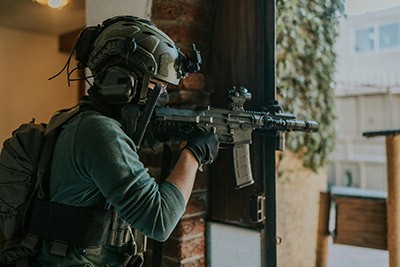






Bulletproof vests, modern protective equipment designed to ensure the safety of soldiers' lives, play a crucial role in specific environments. It can effectively absorb and dissipate the kinetic energy of the warhead and fragments, thereby preventing them from penetrating the human body and ensuring the safety of the protected area. Nowadays, bulletproof vests mainly refer to bulletproof vests that protect the front and back of the chest, aiming to resist the fatal threat of stray bullets and shards to key areas. With the continuous advancement of bulletproof vest technology, while its bulletproof performance is undoubtedly important, lightness and comfort have increasingly become the focus of common concern for both users and producers. This kind of bulletproof vest, which is both practical and lightweight, is gradually winning wide popularity among people.
The evolution process of bulletproof vests
Bulletproof vests, a crucial personal protective equipment, have had a tumultuous development history. Initially, it was mainly made of metal armor protective plates. With the advancement of technology, it gradually transitioned to non-metallic synthetic materials. Nowadays, it has developed into an advanced product integrating multiple composite systems such as synthetic materials, metal armor plates and ceramic protective plates.
In the late 1960s and early 1970s, the birth of Kevlar fibers marked a brand-new historical stage for synthetic fiber technology and also promoted the revolutionary development of bulletproof vest technology. In the following 1991, Dutch scientists invented Twaron fiber and based on this technology, they produced ultra-high molecular weight polyethylene bulletproof vests that were lighter, had better bulletproof performance and better breathability. In 1998, British scientists made a breakthrough by applying high-molecular fiber materials extracted from liquid crystal to the production of bulletproof vests and integrating anti-static materials, thus developing a super bulletproof vest with both bulletproof and anti-static functions. This bulletproof vest not only provides excellent protection on the battlefield, but also offers reliable safety guarantees in places prone to static sparks such as aircraft, ships, oil depots and ammunition depots.
Classification of bulletproof vests
There are various ways to classify bulletproof vests. According to their protection levels, bulletproof vests can be classified into three categories: bulletproof sheets, low-speed bullet protection, and high-speed bullet protection. In terms of style, bulletproof vests can be classified into three types: vest style, jacket style and pullover style. In addition, depending on the different users, bulletproof vests can be further classified into various types, such as anti-puncture vests for ground force personnel, anti-puncture bulletproof vests for vehicle crew members, security bulletproof vests, and bulletproof vests for viPs. Similarly, according to their application scope, bulletproof vests can be divided into two major categories: police and military. From the perspective of the materials used, bulletproof vests can be classified into three types: soft, hard, and soft-hard composite.
Hard bulletproof vests, also known as reinforced bulletproof vests, mainly use special steel plates, super-strong aluminum alloys and other metal materials or hard non-metal materials such as ceramics as their bulletproof materials. Although this type of bulletproof vest has excellent protective effects, it is not very soft and rather heavy. Therefore, military and police personnel usually only wear it in extremely dangerous environments. In contrast, soft bulletproof vests mainly use high-performance textile fibers as bulletproof materials. Combined with the structural characteristics of textiles, they are lightweight, soft and comfortable to wear, thus becoming the first choice for military and police personnel on daily duty.
The soft and hard composite bulletproof vest ingeniously combines the advantages of both soft and hard materials. With a structure featuring a soft inner lining and hard materials for the panel and reinforcing materials, it has become a new trend in the development of modern bulletproof vests. As for the defense capabilities of bulletproof vests, they can be divided into seven levels, ranging from the lowest defense capability of the first category to the highest defense capability of the seventh category. The defense capability of each category is closely related to the type of weapon it can resist.
The defensive performance and principle of bulletproof vests
The defensive performance of bulletproof vests mainly covers two aspects: First, the ability to defend against penetration, that is, to resist the penetration of high-speed fragments produced by bullets or explosions, thereby ensuring that the human body is not directly harmed; Secondly, it is the ability to defend against non-penetrating damage, that is, to minimize the harm to the human body caused by the impact force generated when the projectile or fragments strike the bulletproof vest before it is punctured. The core elements of these defensive performances lie in bulletproof materials and their internal structure.
Bulletproof vests protect the protected parts of the human body in various ways, including absorbing and dissipating the kinetic energy of projectiles, thereby preventing their penetration. Its defense principle can be summarized into two aspects: Firstly, through the "blocking" mechanism, the projectile or fragments are deflected to prevent them from invading the bulletproof vest; Secondly, the "capture" strategy is employed. After accepting the projectiles or fragments, bulletproof materials are used to dissipate their kinetic energy, preventing them from penetrating the bulletproof vest and causing harm to the human body.
The selection of fiber materials for bulletproof vests
There are various types of bulletproof fiber materials, among which para-arylamide fiber (P-ARF) and ultra-high relative molecular weight polyethylene fiber (UFMWPEF) are highly regarded for their superior performance. In recent years, significant progress has been made in the manufacturing process of these two types of fibers, promoting further lightweighting, high performance and comfort improvement of bulletproof products. In addition, after the molecular structure of polybenzodioxazole (PBOF) was improved, its resistance to ultraviolet light and storage stability were significantly enhanced. However, high-end products such as aramid III of the aromatic heterocyclic category, due to their relatively high cost, are mainly applied in the bulletproof and explosion-proof requirements of the national defense and military industry. On the other hand, artificial spider silk, as an amino acid-based highly oriented fiber, has attracted attention due to its high strength, high modulus and high toughness, but it has not yet been fully industrialized. It is worth noting that the emergence of ultra-high-performance carbon fiber has broken the limitations of traditional carbon fiber in the bulletproof field. Its high elongation at break has enabled it to be applied in new military bulletproof equipment, which has profound significance for enhancing the performance of advanced weapons and equipment.
Ultra-high relative molecular weight polyethylene fibers (UFMWPEF) have occupied a wide range of application Spaces in the field of individual bulletproofing due to their low density and excellent mechanical and energy absorption properties.
Evaluation indicators for bulletproof vests
Soft bulletproof vests are usually composed of two parts: the bulletproof layer and the outer jacket. The bulletproof layer, as the core of a bulletproof vest, is usually composed of multiple layers of bulletproof materials. Currently, the mainstream materials on the market include aramid and high-performance polyethylene. In the research and development, production and procurement of bulletproof vests, China adheres to two main standards: GA 141-2001 "General Technical Conditions for Police Bulletproof Vests" and GJB 4300-2002 "Safety Technical Performance Requirements for Military Bulletproof Vests". Meanwhile, the widely adopted American bulletproof vest standard NIJ0101.04 "Ballistic Resistance of Personal Protective Equipment" also covers the assessment of multiple aspects such as bulletproof speed, number of penetration layers, and indentation depth.
The development trend of bulletproof vests
First of all, the key point of bulletproof vests lies in continuously promoting innovation in bulletproof materials and weaving techniques. Hard bulletproof materials aim for lightness, high density, small mass and outstanding bulletproof performance, while soft bulletproof materials emphasize softness, tensile strength, fracture resistance, as well as excellent SP modulus and elongation at break. Meanwhile, in terms of manufacturing processes, the treatment and weaving methods of soft bulletproof fibers will be continuously optimized to further enhance the comprehensive performance of the products. In addition, features such as water resistance, UV resistance and infrared resistance will also become important development directions for bulletproof vests in the future.
Secondly, the diversification of bulletproof vests is also a major trend. In response to the demands of different occupations and environmental characteristics, more styles, colors and designs will be developed to meet users' personalized needs while ensuring convenience and comfort in wearing.
Finally, bulletproof vests are moving towards standardization. At present, the bulletproof standards used in various countries are not uniform, which brings a lot of inconvenience to users. In the future, an internationally unified bulletproof standard is expected to become mainstream to enhance the universality and interchangeability of bulletproof vests.
Bulletproof vests, as important protective equipment for modern armies and police, have played a significant role in reducing casualties among military personnel and police officers while performing their duties since their inception. With the continuous advancement of science and technology, the emergence of new bulletproof materials and the continuous improvement of manufacturing processes, we have every reason to believe that bulletproof vests will have a broader development space in the future.