
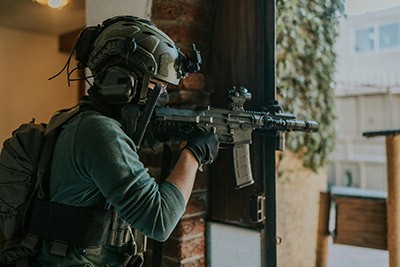







In the ruins of the Syrian battlefield, a soldier was hit in the chest by a 7.62mm rifle bullet but survived thanks to the ceramic composite bulletproof vest on his body. This scene vividly interprets the core value of bulletproof vests - they are not only physical barriers but also the ultimate pursuit of human life protection in the face of violent threats. From the chainmail of ancient warriors to the lightweight battle armor made of modern nanomaterials, every innovation in bulletproof vests reflects the profound changes in materials science, the form of warfare and social demands.
I. Thousand-Year History of Protection: From Metal Armor to the Fiber Revolution
In 2000 BC, ancient Egyptian warriors donned bronze scales to defend against cold weapons, initiating a long exploration of human protective equipment. In medieval Europe, plate armor artisans spent months crafting full-body plate armor, which could weigh up to 30 kilograms. Although it could withstand being slashed by swords and knives, it greatly restricted the mobility of warriors. It was not until the 19th century that the advancement of metallurgical technology gave rise to chain mail and chain mail, which dispersed the impact force through the weaving of metal rings. However, with the advent of firearms, these traditional protective measures quickly lost their effectiveness.
In 1915, in the trenches of World War I, French engineers invented a derivative version of the first generation of steel bulletproof vests, the "Adrian Helmet" - a chest armor made of 1.5-millimeter steel plates, which could resist pistol bullets but weighed as much as 18 kilograms, making it difficult for soldiers to move after wearing it. The real breakthrough occurred in 1965 when DuPont developed Kevlar fiber. This material is five times stronger than steel but as light as a feather. The US military was the first to apply Kevlar to the "Interceptor" bulletproof vests, enhancing the individual soldier's protection capability several times over without affecting tactical movements.
Ii. Decoding Technology: The Protective Secrets of Modern Bulletproof Vests
The protective principle of modern bulletproof vests is based on "energy absorption and dispersion". Take the mainstream soft bulletproof vests as an example. Multiple layers of Kevlar or aramid fibers are staggered and stacked. When a bullet hits, the fibers rapidly stretch and deform, converting the bullet's kinetic energy into thermal energy and the deformation energy of the fibers. Eventually, the bullet slows down and is embedded in the material. Hard bulletproof vests, on the other hand, adopt a "hard against hard" strategy: the ceramic or boron carbide panel on the surface first shatters the bullets, and then the inner steel plate or composite material back plate absorbs the remaining energy.
The dynamic deformation technology adopted by Israel's "Iron Mane" bulletproof vests can be regarded as a model of innovation. The non-Newtonian fluid material filled inside is soft and flexible under normal conditions, but instantly hardens when impacted by bullets, spreading the impact force to a larger area. The "Enhanced Combat Helmet" (ECH) developed by the US Army, through a 3D-printed ceramic composite structure, not only reduces weight but also increases protection against shrapnel by 20%. These technological breakthroughs are constantly pushing the limits of protective equipment.
Iii. Multi-dimensional Battlefield: The Application Landscape of Bulletproof Vests
In the military field, bulletproof vests have become the "second skin" of soldiers. The US military's "Individual Protection System" (IOTV) can resist 7.62mm armor-piercing shells. With a modular design, it can be equipped with side armor and throat armor according to mission requirements. Statistics from the battlefield in Afghanistan show that the mortality rate of soldiers equipped with new bulletproof vests who were shot in the chest has dropped sharply from 42% to 7%. In the field of law enforcement, the lightweight and soft bulletproof vests equipped by police officers can not only be concealed but also resist pistol bullets, playing a key role in anti-terrorism operations.
The civilian market has also seen a sharp increase in demand for bulletproof vests. The stab-proof suits for financial escort personnel are made of ultra-high molecular weight polyethylene fiber, which can resist attacks from knives and sticks. The riot shields equipped by the riot police during the protest activities integrate bulletproof and impact-resistant functions. What's more, high-end civilian bulletproof vests have incorporated fashionable elements. For instance, the Kevlar lined suit launched by the Italian brand perfectly combines protective performance with business attire.
Iv. Future Armor: Infinite Possibilities of Protective Technology
When nanotechnology and artificial intelligence are deeply integrated, bulletproof vests are moving towards an intelligent era. The "self-healing bulletproof vest" developed by the Massachusetts Institute of Technology has microcapsules embedded in its fibers. When damaged, the capsules burst and release repair materials, restoring protective performance within minutes. The "Exoskeleton Bulletproof Vest" project funded by the US DARPA combines the power-assisted system with the protective layer. After soldiers wear it, they can not only withstand heavy fire strikes but also easily carry 200 kilograms of supplies.
Bionics also provides new ideas for protective design. Scientists have developed a "gradient composite armor" by imitating the multi-layered structure of the elytra of beetles. Its hardness gradually changes from the outside to the inside, which can absorb impact energy more efficiently. The application of quantum dot technology has endowed bulletproof vests with the potential for "invisibility" - by adjusting the reflection of light by the material, an optical invisibility effect can be achieved.
From the metal armor of the cold weapon era to the future intelligent battle armor, the evolution history of bulletproof vests is a history of humanity's struggle against violence and protection of life. It not only witnessed the leap in materials science, but also reflected the changes in the forms of war and social demands. As technology constantly breaks through the limits of protection, we may eventually come to a day when bulletproof vests are no longer passive defenses against crises, but become reliable partners for humanity in exploring the unknown and challenging the limits. In this sense, every bulletproof vest is a medal of civilization and progress, engraved with humanity's eternal pursuit of safety and survival.