
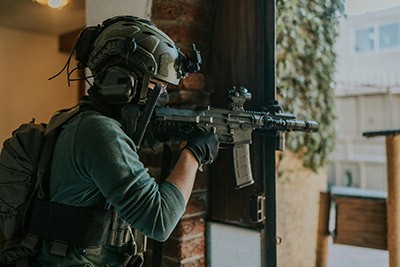






At first, helmets were mainly used in wars to protect soldiers from shrapnel damage. However, with the changing forms of warfare and the continuous advancement of technology, the defensive functions of helmets have been significantly enhanced. At the same time, they also need to be able to accommodate and assist other combat equipment, such as night vision devices and communication equipment. Therefore, in order to meet the demands of modern combat environments, the design and functions of helmets have undergone significant changes.
Helmet classification and characteristics
Currently, bulletproof helmets on the market are mainly divided into three categories: PASGT, MICH and FAST. They each have their own characteristics in structure and function, and users can choose according to their personal needs.
The PASGT helmet is named after the abbreviation of Personnel Armor System for Ground Troops, meaning the personnel armor system of ground troops. Since this helmet was first adopted by the US military in 1983, it has been favored by many military and law enforcement agencies around the world for its outstanding protective performance. Its shell is usually meticulously crafted from multiple layers of Kevlar material and has been strictly evaluated by DARPA, USMC and the US Army. Its protection level has reached IIIA grade, effectively resisting the threat of shrapnel and ballistic projectiles. In addition, soldiers can also attach night vision devices, flashlights and other equipment by installing rails and other accessories according to their personal needs, thus meeting the combat requirements in various complex environments.
The MICH Helmet, whose full name is Modular Integrated Communications Helmet, was developed by improving the PASGT helmet. Compared with the PASGT helmet, the MICH helmet has a more straightforward design. It has removed the brim, chin strap, sweat-proof strap and rope suspension system, and instead adopts an advanced four-point fixation system and an independent memory foam suspension system. These improvements make the MICH helmet more comfortable to wear and enhance its impact defense capability. It is usually made of high-performance Kevlar material and can effectively resist the threat of pistol bullets. In addition, by attaching accessories such as guide rails, this helmet can easily carry night vision devices, flashlights and other equipment, thus meeting the needs of different combat environments.
The core difference between the MICH helmet and the PASGT helmet lies in the improvement of its ear protection design. This change enables the helmet to connect more smoothly with communication equipment, meeting the urgent need for efficient information sharing in modern warfare.
The FAST helmet, whose full name is Future Assault Shell Technology, does not refer to its fast function, but emphasizes its innovative design concept. While meeting the necessary protective requirements, this helmet ingeniously reduces the protective area, thereby achieving a lighter weight and higher wearing comfort. Its unique ear-cutting structure design enables the helmet to smoothly connect with the vast majority of communication devices on the market, perfectly meeting the demand for efficient information transmission in modern warfare. In addition, by simply attaching rail accessories, the FAST helmet can easily carry night vision devices, tactical lights, cameras, glasses and goggles, as well as facial protectors and other equipment, further enhancing its functionality. It is worth noting that the height of the cut at the ear position varies among different models of FAST helmets, which results in differences in the protected area and minor changes in the helmet structure.
The above has introduced the different features of three types of bulletproof helmets, each with its unique design and functions. When making a choice, one should make a reasonable decision based on personal needs and the usage context.
In addition to the difference in helmet shapes, material selection is also an important consideration in the process of choosing bulletproof helmets. At present, there are mainly three materials for making bulletproof helmets in the market: bulletproof steel, Kevlar aramid, and ultra-high molecular weight polyethylene (UHMW-PE). Among them, Kevlar aramid and PE are widely favored due to their superior performance.
Kevlar aramid, this material has been widely used since its introduction due to its excellent bulletproof performance and stability, especially dominating the US military. Although it is slightly inferior to PE in terms of price and certain properties, its strong creep resistance, heat resistance and low deformation rate enable it to maintain excellent performance in high-temperature environments. Therefore, Kevlar aramid remains an ideal choice for helmet manufacturing.
Ultra-high molecular weight polyethylene (PE) has taken the leading position in the bulletproof materials market in fields such as bulletproof vests and bulletproof plates, thanks to its outstanding maintainability, bulletproof capacity and cost-effectiveness. However, the drawback of insufficient creep resistance makes PE helmets prone to deformation during daily use, which to some extent limits their applicability as helmet materials. Despite this, there are still some innovative enterprises such as Haitian Protection that are dedicated to developing new types of helmets that combine the advantages of titanium alloy steel and PE, aiming to provide a perfect solution that is both cost-effective and highly resistant to creep.
When choosing a bulletproof helmet, in addition to considering the differences in helmet shapes, the selection of materials is equally crucial. The common materials used to make bulletproof helmets in the market include bulletproof steel, Kevlar aramid and ultra-high molecular weight polyethylene (UHMW-PE). Among them, Kevlar aramid has been widely praised for its outstanding bulletproof performance and stability, especially maintaining excellent performance in high-temperature environments, and thus is highly favored by the US military. However, ultra-high molecular weight polyethylene (PE) leads the market with its outstanding maintainability, bulletproof capacity and cost-effectiveness. Although PE helmets may deform due to insufficient creep resistance during daily use, innovative enterprises such as Haitian Protection are committed to developing new types of helmets that combine the advantages of titanium alloy steel and PE, in order to provide solutions that are both cost-effective and have strong creep resistance.